Sunscreen reapplication 2026: reminders that work
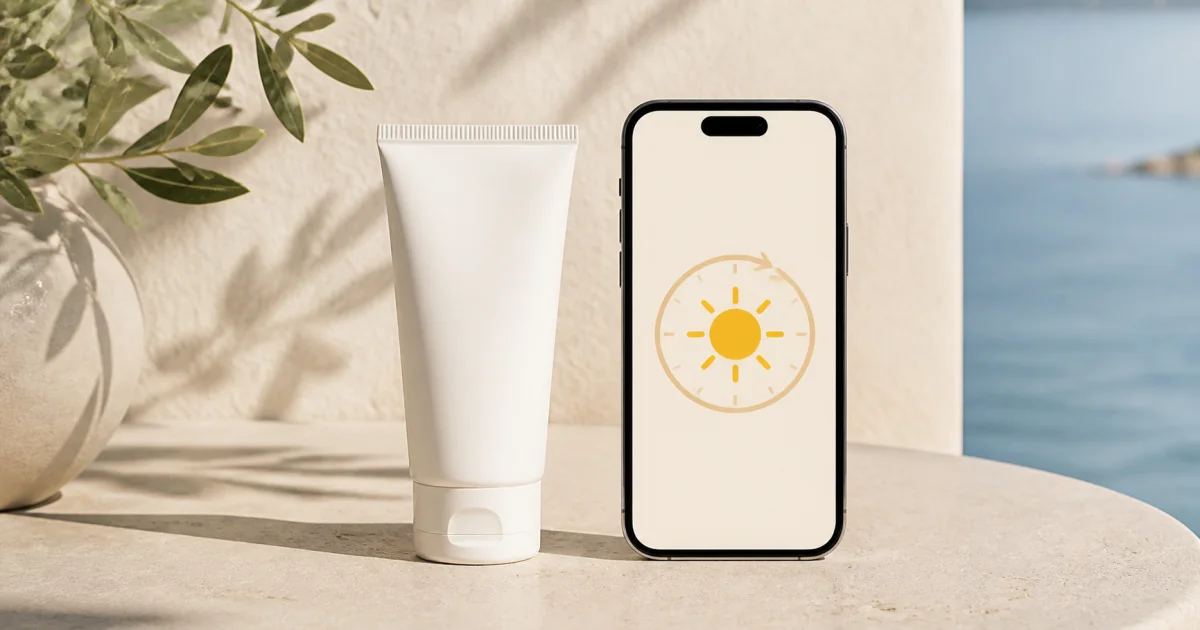
Sunscreen reapplication advice is easy to overgeneralise. The official two-hour interval applies when you are outdoors, and swimming, sweating or towelling can require an earlier application. A phone notification may help you remember, but the studies cited here do not prove that a particular alarm, app or reapplication format works best.
Last updated August 2026.
TL;DR: The American Academy of Dermatology (AAD) advises people to reapply sunscreen every two hours when outdoors and immediately after swimming or sweating. Real-world studies also show frequent under-application. A randomised trial found better daily sunscreen use with text messages, but it did not study two-hour reapplication or compare reminder tools directly. Use a prompt if it helps, keep the product accessible, and follow the label.
When does the two-hour rule apply?
The AAD recommends a broad-spectrum, water-resistant sunscreen with SPF 30 or higher, applied before going outdoors. To remain protected outdoors, it says to reapply every two hours and immediately after swimming or sweating. The NHS sun-safety guidance also notes that towelling and perspiration can remove product.
This is exposure guidance, not a universal timer that must run from morning to night in every setting. Product directions also matter because water-resistance claims and application instructions differ. Reapplication complements shade, clothing and other sun-protective measures; it does not replace them.
Under-application matters, but it does not produce a universal effective SPF
SPF testing uses a specified laboratory application dose. A review by Petersen and Wulf reported real-world amounts of 0.39 to 1.0 mg/cm2, below the 2 mg/cm2 test dose discussed in the paper.
That gap matters, but there is no universal conversion from a fraction of the test dose to an effective SPF. Formula, film uniformity, application technique and test conditions all affect the relationship. The label number should therefore not be converted into a personalised protection number with a simple shortcut. Our SPF 30 versus SPF 50 guide explains what the label calculation does and does not establish.
A laboratory study by Heerfordt and colleagues observed 31 volunteers applying sunscreen twice while wearing swimwear. The reported mean amount rose from 0.71 mg/cm2 after the first application to 1.27 mg/cm2 cumulatively after the second. This supports careful coverage and shows that a second pass can increase the amount present. It does not establish a fixed face-and-neck quantity for every person or product.
What research says about an early second application
A mathematical model by Diffey compared reapplication schedules during several hours in strong midday sun. Under the model's assumptions for products that bound moderately or well to skin, reapplying 20 minutes after exposure began produced 60% to 85% of the ultraviolet exposure estimated for reapplication at two hours. The paper proposed applying before going outdoors and adding an early second application after exposure begins.
This was a model, not a clinical trial assigning one schedule to every user. An early second pass can be a useful way to cover missed areas before sustained outdoor exposure, but it does not cancel the product label or current public-health advice to reapply every two hours when outdoors and after swimming or sweating.
Do phone reminders improve sunscreen use?
There is evidence for some digital prompts, but the outcome and comparison need to be described precisely.
A six-week randomised trial by Armstrong and colleagues assigned 70 participants either to daily text messages or to no messages. Sunscreen use was monitored electronically. Mean daily adherence was 56.1% in the message group and 30.0% in the control group. This supports text prompts for daily use in that study; it did not test reapplication every two hours.
A separate trial by Buller and colleagues studied a mobile app that offered personalised sun-protection advice. It reported improvements in some behaviours, including shade seeking, but not in sunscreen use. A systematic review of 62 digital sun-protection studies found generally promising results while also showing varied interventions and outcomes.
These studies did not compare a phone alarm directly with a dedicated app. They also do not establish that calendar alarms, weather alerts or habit stacking are equivalent. A simple reminder is a reasonable personal aid if it helps you follow established guidance, but it should be presented as a convenience rather than a clinically proven winner.
How to set a useful reminder without overstating the evidence
A practical prompt can include three pieces of information:
- Context: use it for periods when you expect to be outdoors, rather than scheduling an all-day alert without considering exposure.
- Action: name the application area and remind yourself to follow the amount and application directions on the product label.
- Access: keep the same product, or another product whose label you can follow, where the reminder can be acted on.
Weather or UV Index notifications can help identify when outdoor protection is relevant. The US Environmental Protection Agency UV Index explains that the index forecasts expected ultraviolet radiation and should be used with protective actions. It does not determine a personalised reapplication prescription on its own.
A schedule should follow exposure, activity and the label
There is no single number of daily applications that fits an indoor workday, a commute, a beach day and outdoor sport.
Before planned outdoor exposure, apply sunscreen as directed, cover all exposed skin and allow the lead time stated by the product or applicable guidance. While outdoors, use the two-hour interval and reapply earlier after swimming, sweating or towelling. If an early second pass helps correct missed areas, treat it as an addition to those instructions rather than a replacement.
The amount required depends on the area covered, body size, formulation and label. Whole-body public guidance can be useful as an orientation, but it should not be converted into one universal face-and-neck dose. Apply enough to cover exposed skin evenly and follow the product's directions.
Reapplying over makeup
The cited reminder and dosing studies do not rank cushion, stick, spray, powder, lotion or cream formats for use over makeup. Different formats also have different label instructions, so a universal hierarchy would be misleading.
Choose a labelled sunscreen you can apply evenly and in the stated amount. Do not assume that a light dusting of powder, a few stick passes or a short spray automatically restores the labelled protection. Filter category does not change that requirement; the chemical-versus-mineral sunscreen guide explains the category distinction without turning it into a durability claim. If pigmentation is a concern, our tinted sunscreen evidence review separates ultraviolet protection from formulation-dependent visible-light evidence.
Indoor days, windows and individual medical advice
Public guidance consistently focuses reapplication on outdoor exposure. Indoor exposure varies with time near windows, glass type, direct sunlight and any outdoor travel. A universal indoor timer is therefore not supported by the sources reviewed here.
Indoor reapplication depends on actual exposure and individual clinical advice. If you use a medicine that carries a photosensitivity warning, have a condition affected by light, or are following a clinician-directed pigmentation plan, use the medicine label and your clinician's advice rather than a generic schedule from an article.
Common mistakes
- Treating the two-hour interval as permission to ignore swimming, sweating, towelling or the product label.
- Applying too little or missing exposed areas, then trying to calculate a personal SPF from the fraction used.
- Assuming one over-makeup format restores the label without applying it according to its directions.
- Quoting a daily text-message trial as proof that a specific reapplication app is superior.
- Relying on sunscreen alone instead of combining it with shade and protective clothing.
FAQ
How often should I reapply sunscreen?
The AAD says to reapply every two hours when outdoors and immediately after swimming or sweating. Towelling can also remove product. Follow the label, and reapply sooner when the directions or activity require it.
Does a phone reminder improve reapplication?
The best-known randomised text-message trial measured daily sunscreen use, not two-hour reapplication. It found higher adherence with daily messages than with no messages. A reminder may still be useful, but current evidence does not identify one best reminder format for reapplication.
How much sunscreen should I use on my face and neck?
The sources reviewed here do not support one universal gram or teaspoon amount for every face, neck and formula. Follow the amount and application directions on the product label and cover exposed skin evenly. Public-health guidance also gives broader whole-body examples, but those are not a personalised face-and-neck calculation.
Is powder sunscreen enough over makeup?
Do not assume that a light powder application restores the labelled SPF. Use a sunscreen format that you can apply evenly and according to its directions. The evidence cited here does not establish a universal ranking of makeup-compatible formats.
Do I need to reapply indoors?
There is no universal indoor schedule in the cited guidance. Consider actual outdoor time and window exposure. People with photosensitising medicines or light-sensitive conditions should follow the relevant label and clinical advice.
Does higher SPF replace reapplication?
No. A higher tested SPF does not prevent product from being removed by swimming, sweating, towelling or rubbing. Follow the label and the current outdoor reapplication guidance.
Should I reapply when it is cloudy?
Cloudy weather does not by itself eliminate ultraviolet exposure. When you are outdoors, use local UV guidance alongside sunscreen directions, shade and protective clothing.
Bottom line. The strongest claims here are narrow: people often apply less sunscreen than laboratory testing uses; an early second pass can improve coverage under studied conditions; and daily text messages improved daily adherence in one randomised trial. None of those findings proves a universal dose shortcut, an indoor schedule or a best reminder app. Keep the prompt practical and keep the guidance tied to exposure, the label and current public-health advice.
Sources and further reading: AAD sunscreen guidance, NHS sunscreen and sun safety, Petersen and Wulf, application of sunscreen: theory and reality, Heerfordt et al., photoprotection depends on time spent on application, Diffey, when should sunscreen be reapplied, Armstrong et al., text-message randomised trial, Buller et al., sun-protection app randomised trial, Niu et al., digital-interventions systematic review, EPA UV Index.
Enjoyed this? Share it