Cruelty-free skincare in 2026: checking claims, scope and certification
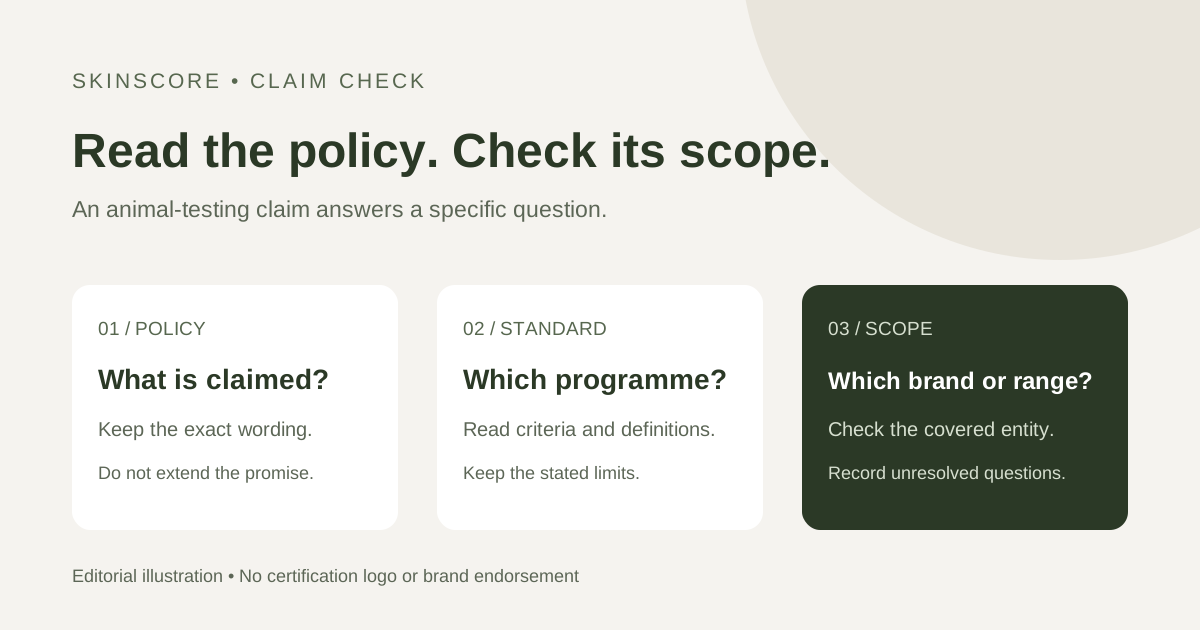
Cruelty-free skincare is easier to assess when you replace a broad promise with specific questions. Who makes the claim? Which products does it cover? What standard does it use, and what evidence can you check?
This guide explains the EU framework and the accessible published North American Leaping Bunny standard. It does not certify a brand, compare certification schemes or report a supplier audit. A bottle's logo alone cannot answer every question about a company's testing policy.
What the EU ban covers
The European Commission's explanation of the cosmetics animal-testing ban distinguishes testing bans within the EU from a marketing ban. The final marketing-ban deadline was 11 March 2013. Article 18 frames these prohibitions around testing to meet the Cosmetics Regulation's requirements.
That scope matters. A product being offered in Europe is not proof that a particular company's entire worldwide range satisfies a named private certification. Nor does the existence of a legal rule prove that every seller complies with it. Avoid replacing a specific policy check with “sold in the EU, therefore certified cruelty-free.”
For a claim about absence of animal testing, Article 20(3) addresses the manufacturer and suppliers, finished products and prototypes, ingredients, and animal testing by others for developing new cosmetics. A statement limited to the brand's own laboratory does not answer all of those questions.
What the published Leaping Bunny standard actually says
The Corporate Standard of Compassion for Animals, published by the Coalition for Consumer Information on Cosmetics (CCIC), describes approval for a company's own-label cosmetic and household products. These are the terms in the linked North American document. Confirm current programme requirements before relying on a particular approval; programmes using related terminology may differ.
Its criteria cover company testing, purchases from manufacturers and suppliers after a fixed cut-off date, a supplier monitoring system and annual recommitment. Monitoring can use compliance declarations or specified purchase-order wording. The standard includes independent-audit provisions; it does not say that every supplier receives an annual on-site inspection.
Read the definitions as well as the headline. The document excludes certain ingredient testing required by law when it was not conducted to assess the safety, efficacy or environmental effects of cosmetics or household products. It also gives an exception from raw-material declarations for defined natural agricultural ingredients. These limits should not be erased when summarising the programme.
A fixed cut-off date is a policy boundary for the testing addressed by the standard. It is not a promise that every ingredient has never been tested on animals at any point in history.
How to check a specific claim
First, copy the exact wording from the product page or packaging. “We do not test our finished products” and a named certification are different statements. Record them as written rather than upgrading one into the other.
Next, follow the link to the named programme. Check that the entry, if available, identifies the brand or range you are considering. A parent company, similarly named business or distributor is not automatically the same entity. Note when you checked the information and which market's product page you used.
If you cannot confirm a current entry or its scope, ask the programme or brand for clarification. Until then, write “not independently confirmed in this check.” Missing public information does not prove that animal testing occurred, and it does not establish that approval exists.
Our brand transparency checklist can help organise those notes. It intentionally avoids invented numerical ratings or claims that we audited suppliers ourselves.
Overseas sales need a specific answer
The CCIC document includes conditions about animal testing for submission to foreign regulatory agencies. For an overseas-sales question, ask which programme and rules apply to the exact products and distribution route concerned. An old general statement is not sufficient evidence for a current case.
This guide does not make a blanket claim about cosmetics sold in China, or decide whether a particular brand is eligible for approval there. That would require current primary rules and programme confirmation for the relevant category and route. Do not infer testing from a country name alone, or infer an exemption without its conditions.
Animal-testing policy and vegan ingredients are separate questions
An animal-testing statement concerns testing. A claim about absence of animal-derived ingredients concerns composition. Check both separately when both matter to your purchase. Do not translate a bunny symbol into an ingredient assurance that it does not explicitly provide.
An ingredient list can help you formulate questions, but it is not a supplier declaration or a testing-history record. See our ingredient-list reading guide for the related label-reading task. Ask for the scope and evidence of any separate vegan claim rather than trying to infer it from certification for a different purpose.
Keep performance claims separate too
Approval under an animal-testing programme does not supply a study showing that a moisturiser hydrates better, that a sunscreen performs differently or that a product suits everyone. A claim about an effect needs its own supporting evidence.
The EU common criteria for cosmetic claims require evidence appropriate to the claim and prohibit presentations that exceed the support available. Our guide to dermatologist-tested wording addresses another claim whose meaning needs to be checked separately.
Frequently asked questions
Is every skincare product sold in the EU independently certified cruelty-free?
No. The EU legal framework and approval by a named private programme are different. Check the programme and covered entity separately.
Does a fixed cut-off date mean an ingredient was never tested on animals?
No. It is a boundary for the testing addressed by the standard, not a complete historical record for every ingredient.
Does the CCIC standard require annual on-site audits of every supplier?
That is not what the published document says. It includes supplier monitoring, annual recommitment and independent-audit provisions, with specific conditions and definitions.
Does a cruelty-free claim prove the product has no animal-derived ingredients?
No. Ask for the scope and evidence of a separate composition or vegan claim.
Can a country's name tell me whether a particular product was tested?
No. A current, product-specific answer requires the applicable rules, category, distribution route and relevant programme conditions.
What if I cannot verify a brand's certification claim?
Ask the named programme or brand for clarification and record the status as unconfirmed. Do not turn an unresolved check into approval or an accusation.
Enjoyed this? Share it