Skincare brand transparency: what you can actually verify in 2026
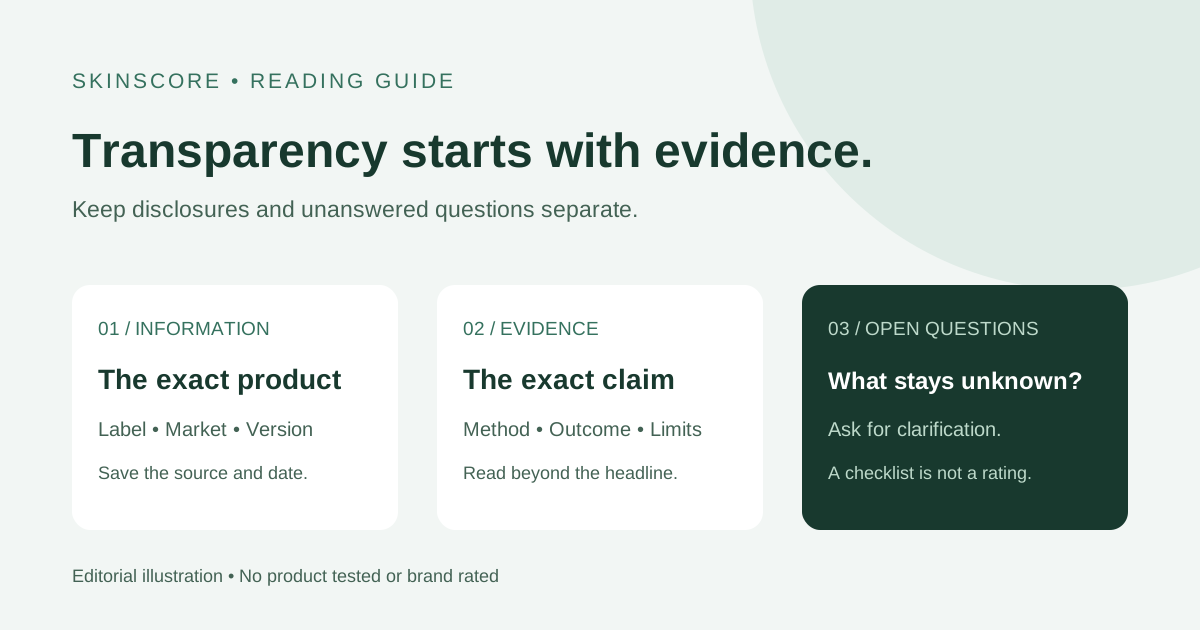
Skincare brand transparency is useful when it helps you answer a specific question about a specific product. An ingredient list, a concentration statement and a study summary answer different questions. Combining them into a single impressive number can hide those differences.
Start with the product you are considering, rather than the brand's reputation. Save its name, market, ingredient list and the exact claim that matters to you. Then ask what evidence you can actually inspect. This guide offers a reading checklist; it does not report a survey, laboratory analysis or completed audit of any brand.
Begin with the label, but respect its limits
For EU products, Article 19 of the Cosmetics Regulation sets ingredient-label rules. Ingredients are generally ordered by weight when added; those below 1% can appear in any order after those above 1%. Fragrance has specific naming rules. An ingredient's position therefore cannot reveal its exact percentage.
Compare the packaging with the product page for the same version and market. If they differ, record the difference and ask which list applies to the item being sold. A mismatch is a question to resolve, not enough information to declare that a company falsified its formula.
Our ingredient-list reading guide provides related background. For this check, keep the original spelling of the ingredients and a dated copy of the page instead of relying on a retailer's abbreviated description.
Read a percentage claim as a question about the finished product
If a product advertises a percentage, ask what the number measures. Does the brand mean the named ingredient itself, a blend containing that ingredient, or a supplied solution? Copy the full wording, including any explanation nearby. Do not silently treat a percentage of a blend as a percentage of its individual component.
A concentration statement can make a claim more specific. It cannot, by itself, establish the performance of the finished product or predict an individual's response. This checklist does not infer a clinical threshold from an ingredient's position, nor does it supply a universal percentage that every product must reach.
When a percentage is not published, write “not disclosed in the materials checked.” That describes your observation. It does not establish that the concentration is low, that the product is ineffective, or that the brand acted dishonestly.
Match the evidence to the wording of the claim
Regulation (EU) No 655/2013 requires adequate, verifiable evidence for cosmetic claims. When studies are used, they should be relevant to the product and benefit claimed. Its criteria also limit unsupported extrapolation from ingredient properties to a finished product, overstated performance and claims suggesting EU authority approval.
For a claim such as “users reported softer-feeling skin,” look for information about the questionnaire and participants. For a measured change, look for the measurement, timing and comparison. Ask whether the study concerned the product being sold or another formulation. These questions help you understand the evidence; answering them does not turn a reading exercise into an independent scientific review.
A useful study summary makes its method and limitations visible. Note the product tested, number of participants, duration, outcome and any comparison group that is reported. If a detail is missing, leave it unknown. Avoid rewriting a consumer opinion as an instrument measurement, or a study's limited finding as a promise to every buyer.
The guide to dermatologist-tested wording discusses another label worth reading carefully. A short phrase on a pack is a starting point for questions, not a substitute for the underlying information.
Public information is different from the regulatory file
EU Articles 11 and 21 distinguish the product information file available to authorities from public-access requirements. Commercial secrecy and intellectual property receive protection; required public quantitative composition information is limited to hazardous substances. Do not assume every concentration, supplier record or full dossier must be posted online.
You can still ask for an explanation of a claim, a current ingredient list or a study summary. A clear answer may help your decision. An unanswered request leaves a gap in the information available to you; it does not establish a legal violation.
A practical transparency record
Use separate entries rather than adding points. The following is an editorial checklist, not a validated rating system.
| What to record | A useful follow-up question |
|---|---|
| Product name, market and version | Does this information match the item I can buy? |
| Ingredient list and its source | Is this the current packaging list or a retailer's copy? |
| Exact wording of a concentration claim | Does the number describe an ingredient or a blend? |
| Exact benefit claim and linked evidence | Was this product tested for this particular outcome? |
| Missing information | Can the brand clarify it, or should it remain unknown? |
Save links and the date you checked them. When the formula or claim changes, create a new entry instead of silently updating the old one. A record of one product also should not become a verdict on everything its parent company sells.
For example, imagine an unnamed serum whose page provides an ingredient list and a percentage but only a brief study headline. You can record the first two disclosures and request the study details. You cannot responsibly assign it an “85/100” score, declare it superior, or conclude that all competing products are less honest. This is a hypothetical example, not a product we audited.
Keep transparency separate from other decisions
Disclosure can help you compare information, but it does not answer every purchasing question. Keep price, suitability, testing policy and the stated benefit in separate parts of your notes. For animal-testing claims, use our cruelty-free label guide rather than awarding transparency points for a logo alone.
If a source cannot answer your question, you can postpone the purchase or choose a product with information that better addresses your priorities. You do not need to turn that personal decision into an accusation about the brand.
Frequently asked questions
Is this a SkinScore ranking of skincare brands?
No. This article supplies a reading checklist and a hypothetical example. It does not assign scores or report completed brand audits.
Can I calculate an ingredient's percentage from its place on the list?
No. List position does not provide an exact concentration, including because EU rules allow flexibility below 1%.
Does an undisclosed percentage mean the product does not work?
No. It means that percentage was not available in the materials you checked. It does not prove or disprove the product's performance.
Must every brand publish its entire regulatory dossier?
Do not confuse public information with the file available to authorities. The EU provisions described above include limits and confidentiality protections.
Does more disclosure prove a product is safer or more effective?
No. The checklist records information you can inspect. It does not measure safety, effectiveness or suitability for an individual.
What should I do when the packaging and website differ?
Record both versions and ask which applies to the product being sold. Leave the discrepancy unresolved until you have an answer.
Enjoyed this? Share it